Change happens when funding turns ideas into action
June 30, 2026
Strong communities are built through collaboration, innovation and a shared commitment to addressing local needs. As a grantmaking organization, MCF supports a wide range of nonprofits whose work creates meaningful, lasting change. While funding helps turn ideas into action, the true measure of success lies in the outcomes achieved and the lives affected.
Here are three projects MCF has supported with our Community Impact and Field of Interest grantmaking. Their stories illustrate the power of strategic investment, dedicated leadership and community engagement. They highlight what can be accomplished when resources and vision come together to address important local challenges.
Providing a Unique Community Resource: Urban Tree Alliance
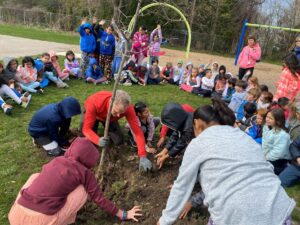 Madison is full of energy in the summertime. People are out biking, enjoying pools, beaches and playgrounds, and spending time outdoors. However, some neighborhoods in Madison aren’t as equipped to fend off the summer heat as others. These neighborhoods lack tree cover and shade, making it more difficult for people to enjoy spending time outside. Urban Tree Alliance, a nonprofit focused on preserving and growing the urban forest canopy in the Greater Madison area, worked to address this issue through its Neighborhood Forest Project.
Urban Tree Alliance began the Neighborhood Forest Project by identifying neighborhoods in Madison that had few or no mature trees or low tree canopy coverage. They chose to focus on an area that covers a large portion of Madison’s South Side along with sections of Monona and Fitchburg. In addition to having low tree canopy cover, these neighborhoods also have high proportions of low-income households and low rates of owner-occupied housing. Approximately 29,000 people live within the neighborhoods covered by the Neighborhood Forest Project, 30% of whom identify as Latinx.
In 2024 and 2025, the Urban Tree Alliance planted nearly 220 trees in the project area, significantly exceeding the project’s goal of 160 trees. To do this, the organization partnered with Operation Fresh Start’s Legacy Conservation crews to plant, water, mulch and replace the trees as needed. Trees were planted at a variety of public and private spaces across the area, including:
- Public greenways,
- Four area schools,
- Private residences,
- Streets in Southdale and Leopold neighborhoods,
- Wisconsin Literacy Network,
- Zion Baptist Church,
- Maple Glen Apartments,
- City of Madison Fire Station 7, and
- Hugel Park in Fitchburg.
The Neighborhood Forest Project also provides a way to engage with people in these communities. Working with community partners like Capital Area Regional Planning Commission and Wisconsin Eco Latinos, Urban Tree Alliance teaches people about the importance of trees and protecting and sustaining the environment. Along with Operation Fresh Start, Urban Tree Alliance has participated in outreach at area schools and community events at Centro Hispano and Literacy Network.
The Neighborhood Forest Project shows no signs of slowing down. The $50,000 grant from MCF’s Community Impact Fund in 2024 allowed Urban Tree Alliance to invest in additional staff and maintain focus within the project area. This investment and the momentum it created were instrumental in securing a $450,000 grant from the Wisconsin DNR.
Learn more about Urban Tree Alliance at https://www.urbantreealliance.org/
Building to Meet Changing Needs: Madison Area Rehabilitation Centers
 In 1973, Wisconsin became the second state to adopt a mandatory education law that allowed children with disabilities to attend public schools. Prior to this, it was up to the families of children with intellectual and developmental disabilities to provide educational opportunities for their children.
While this law was a triumph for disability rights, it didn’t address the needs of adults with disabilities who were no longer eligible for public school services. Madison Area Rehabilitation Centers stepped up to meet this need. In the late 1960s and early 1970s, it began providing services for adults with intellectual and developmental disabilities.
Today, MARC supports 375 people at six locations across Dane County and at more than 150 community-based job sites daily. MARC provides education, employment training programs and specialized day services that emphasize the importance of choice, the joy of work and the power of compassion.
By 2023, MARC’s Mount Horeb location was in desperate need of a new building. The cramped offices, classrooms and common spaces could not keep pace with the growing needs of the community. The building also lacked adequate sensory-sensitive rooms, outdoor spaces and individualized program areas. Very few options exist for services for adults with intellectual and developmental disabilities in rural communities, making the Mount Horeb location critical for providing services. The building expansion project needed to happen quickly.
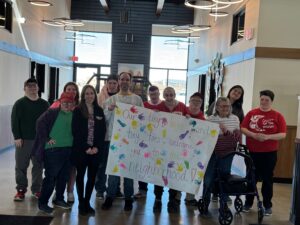
MCF supported MARC’s building expansion project in 2024 with a $50,000 grant from the Community Impact Fund. On June 7, 2024, MARC broke ground on a new 13,500-square-foot building with improved facilities for education, exercise, employment, recreation and a deepened connection to the community. The construction finished in March 2025, and MARC staff and its participants settled into their new home shortly after.
The new building’s accommodations, and the addition of four staff members, allowed MARC to welcome six new clients within the first two months of the new building opening The new facility will allow MARC to double the number of participants in its Mount Horeb programs and provide more than a dozen new jobs at local businesses in the next five years.
Learn more about MARC at https://marc-inc.org/
Serving a Vulnerable Population Through Legal Aid: LOTUS Legal Clinic
 Human trafficking can feel like an issue that is far from home in Dane County. But the National Human Trafficking Hotline received 277 calls from Wisconsin in 2024 alone. While people have become more aware of human trafficking and its victims, only a handful of organizations in Dane County focus on helping human trafficking survivors.
As the only Wisconsin law firm offering free legal services to survivors of human trafficking and sexual violence, LOTUS Legal Clinic helps provide them healing and a pathway to justice. Founded in 2016, LOTUS believes that everyone has a right to dignity and safety that is both healing and equitable.
LOTUS supports survivors by providing an innovative blend of legal services, victims’ rights representation and therapeutic arts programming. In 2024, LOTUS served 112 people in the state, including eight people in Dane County.
Human trafficking survivors often face a host of legal matters stemming from their victimization. This might include victims’ rights representation, school and workplace protections, safety planning, and more. In 2024, 83% of the survivors LOTUS served were foreign nationals who also needed immigration representation.
But healing requires more than addressing legal matters. That’s where LOTUS’s therapeutic arts programming comes in, with programs like the Untold Stories program.
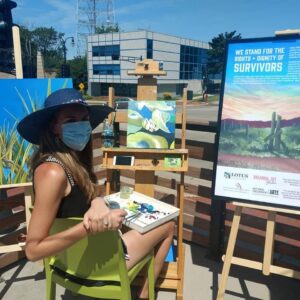
Untold Stories helps survivors reflect on and process their sexual trauma and its aftermath. The stories are expressed through poetry and creative nonfiction. Through partnership with student-artists at the Milwaukee Institute of Art & Design, the stories are transformed into visual art. Untold Stories helps survivors collaborate and use art as an outlet for creative expression, personal healing and genuine community.
In 2024, MCF awarded LOTUS a $6,000 Field of Interest grant to help cover their lawyers’ salaries so they can continue to offer their services, and valuable programs like Untold Stories, at no cost to clients.
Learn more about LOTUS Legal Clinic at https://www.lotuslegal.org/